Why Is Fabric Selection Important for a Period Underwear Manufacturer?
Fabric selection affects how period underwear absorbs fluid, feels against the skin, survives washing, and fits after repeated wear. A typical product may combine 3–5 textile layers, with body fabrics around 150–220 GSM and absorbent components often above 180 GSM. Moving from 180 GSM to 240 GSM adds 33% more material mass before construction changes are counted. Manufacturers also need to check wicking, drying time, stretch recovery, shrinkage, hydrostatic resistance, colorfastness, and lamination strength. A fabric that performs well alone can still perform poorly when sewn into a multilayer gusset, so approval should include both material and finished-garment testing.
Period underwear is closer to a textile system than ordinary briefs. The body fabric has to stretch and recover, the skin-contact layer needs to move fluid away from the surface, the absorbent layer stores it, and a barrier helps stop moisture reaching outer clothing. A 4-layer gusset can therefore contain materials with completely different fiber structures, thicknesses, and moisture behavior.
That structure explains why absorbency cannot be judged by one fabric specification. A 200 GSM absorbent knit covering 250 cm² contains about 5 grams of textile per layer before seams, finishes, or moisture are added. Increasing it to 260 GSM raises material mass in the same area by 30%, but capacity does not automatically increase by exactly 30% because fiber chemistry, pore structure, compression, and liquid distribution also matter.
Fluid acquisition is equally important. If menstrual fluid stays on the top surface for too long, the user can feel damp even when the absorbent layer underneath still has unused capacity. AATCC maintains separate methods for textile absorbency, liquid moisture management, vertical wicking, horizontal wicking, and drying, including TM79, TM195, TM197, TM198, TM199, and TM200 in its 2026 testing program.
Capacity, transfer speed, surface dryness, and retention should be measured separately. Reporting only “holds 30 mL” leaves out how quickly that 30 mL moves through the first layer and how much returns to the surface under pressure.
Fiber choice changes those measurements. Cotton and regenerated cellulose fibers are hydrophilic and can absorb moisture into the fiber structure, while polyester generally absorbs far less moisture within the fiber itself but can transport liquid effectively when yarn geometry, capillary spaces, and finishing are designed for wicking. A blend that contains 5–10% elastane may improve body fit, but elastane is normally present for stretch rather than liquid storage.
The manufacturer therefore has to balance absorption with thickness. If two absorbent layers are each 220 GSM, their combined nominal textile mass is 440 GSM before the top sheet and waterproof component are included. Increasing both layers to 260 GSM raises that figure to 520 GSM, an 18.2% increase, which can affect crotch thickness, sewing pressure, drying time, and material consumption.
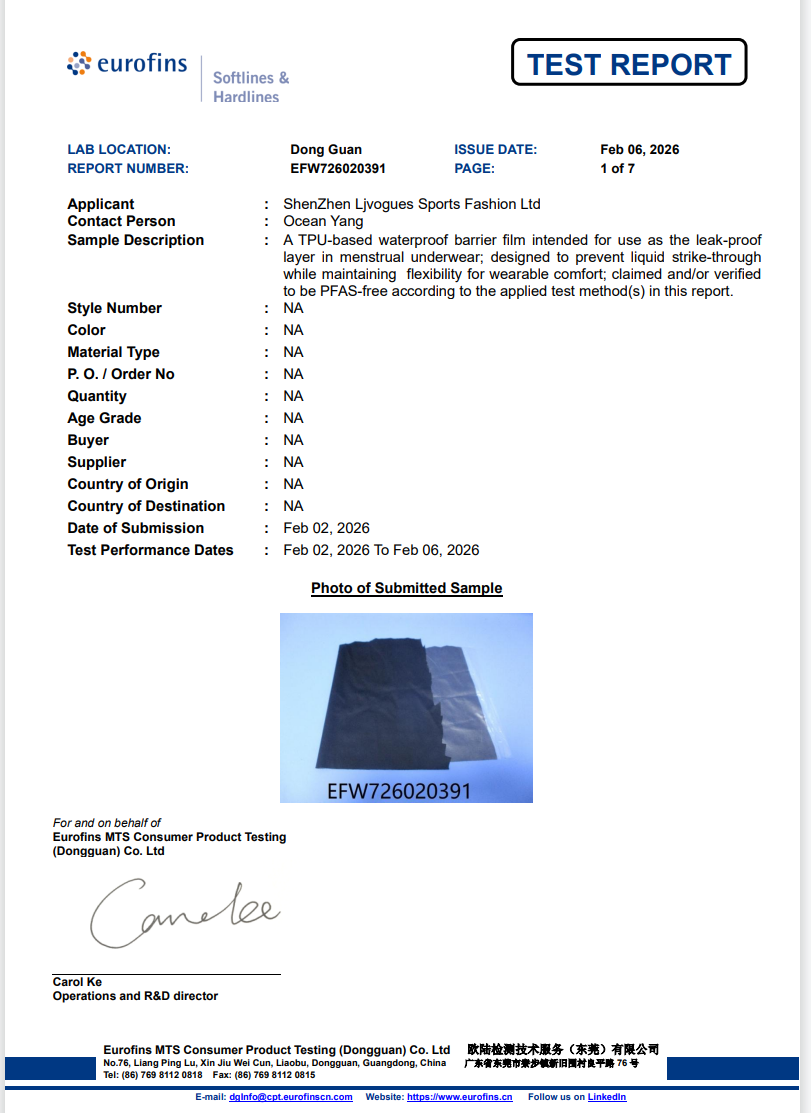
Barrier selection adds another set of trade-offs. TPU films and laminated waterproof textiles are widely used because very thin films can resist liquid while remaining flexible enough for underwear. Film thickness alone should not be used as a quality rating; membrane formulation, lamination adhesive, textile backing, hydrostatic resistance, and repeated washing all influence performance.
A manufacturer can assess water resistance with established textile methods rather than relying on visual inspection. AATCC TM127 covers resistance to water under hydrostatic pressure, while AATCC also lists TM22, TM35, and TM42 for other forms of water resistance and repellency testing in 2026.
| Material area | Typical specification to control | What can go wrong when poorly matched |
|---|---|---|
| Body fabric | 150–220 GSM; often 5–15% elastane in stretch blends | Bagging, tight leg openings, excessive shrinkage |
| Transfer layer | Wicking and surface-dry behavior | Pooling or prolonged wet feeling |
| Absorbent layer | 180–300+ GSM depending on construction | Low capacity, bulk, long drying time |
| Barrier layer | Film/laminate resistance plus bonding quality | Leakage, stiffness, delamination |
| Finished gusset | Often 3–5 functional layers | Excess thickness or uneven fluid distribution |
GSM also changes purchasing economics. If Fabric A weighs 160 GSM and Fabric B weighs 200 GSM, Fabric B uses 25% more textile mass for the same cut area. For a production run of 20,000 garments, even a few grams added to every unit can translate into tens of kilograms of extra fabric, before cutting loss and rejected material are included.
Weight, however, cannot replace stretch data. Two 180 GSM fabrics may look almost identical while behaving very differently after 50 extension cycles. One may return close to its starting dimensions; another may remain elongated around the seat or leg opening. Period underwear needs stable recovery because movement between the body and gusset can affect coverage during walking, sleeping, and exercise.
Shrinkage creates a similar compatibility problem. Suppose the body fabric loses 4% in length after laundering while the laminated gusset changes by only 1%. On a 300 mm fabric section, that difference can approach 9 mm. Once different materials are stitched together, uneven dimensional change can produce puckering, curling, or distortion even though neither material has technically “failed.”
For that reason, pre-production approval should include repeated laundering rather than one wash. A development program may compare measurements after 1, 5, 10, 20, and 30 wash cycles and record width, length, stretch recovery, surface condition, laminate adhesion, absorbency, and leakage. AATCC TM135 specifically addresses dimensional changes after home laundering, while TM124 covers fabric appearance after home laundering.
Drying behavior should be measured during the same program. A heavier cellulose-rich gusset may retain more wash water than a lighter synthetic structure, so a product that absorbs well during wear may take longer to air-dry afterward. A 20% increase in retained water can matter for customers rotating only 3 or 4 pairs and washing them several times per week.
More absorbent material is not always a better specification. If extra capacity raises bulk and drying time far beyond what a light- or moderate-flow product needs, the garment may become less comfortable without improving normal use.
Comfort also depends on surface friction and air movement. A soft fabric sample tested by hand for 20 seconds tells little about how it feels after 8 hours of wear or 20 wash cycles. Mills and manufacturers should compare pilling, surface roughness, moisture transport, stretch, and washed hand feel because finishing agents used during production can change after repeated laundering.
Color requires separate control. Dark period underwear is common, but deep shades can show crocking or staining problems when dye fixation is weak. AATCC’s 2026 colorfastness program includes TM8 for crocking, TM15 for perspiration, TM61 for accelerated laundering, and TM107 for water. Testing several specimens from separate dye-lot positions gives more useful information than approving one hand-cut swatch.
Chemical requirements also influence fabric sourcing. OEKO-TEX STANDARD 100 tightened its PFAS-related requirements from January 1, 2026, including a total fluorine limit of 50 mg/kg in its published criteria. Requirements can vary by destination market and certification route, so brands should obtain current test reports rather than accept a supplier statement saying only “PFAS-free” or “eco-friendly.”
The same approach applies to dyes, finishes, adhesives, printing chemicals, and antimicrobial treatments. An antimicrobial finish may perform on new fabric but lose activity after 10 or 20 washes, while some finishes can alter wicking or softness. If odor-control performance is part of the product specification, testing should cover the treated finished fabric after the intended laundering sequence instead of only testing an untreated laboratory swatch.
Manufacturing behavior needs equal attention because fabric properties affect cutting and sewing. A highly elastic knit may relax after spreading, a lightweight jersey may curl at cut edges, and a thick 4-layer gusset may require different needle size, stitch density, presser-foot pressure, or seam construction than standard underwear.
A small time difference becomes measurable at production scale. Adding 15 seconds of handling to a difficult gusset operation creates about 83 extra labor hours across 20,000 units. Material price per meter therefore gives an incomplete cost picture; cutting yield, sewing speed, defect rate, rework, shrinkage allowance, and usable fabric width should be calculated alongside the purchase price.
Consistency between rolls matters for the same reason. A factory can approve a 200 GSM development sample, then receive bulk rolls at 188 GSM and 212 GSM. That range is about ±6% around the nominal figure and may change opacity, stretch, absorption, cutting yield, or finished garment weight depending on the textile.
Incoming inspection should therefore use defined tolerances and multiple samples. For example, a 10-roll shipment can be checked at the beginning, middle, and end of selected rolls rather than relying on one specimen. Width, GSM, shade, shrinkage, stretch, and visual defects can then be compared with the approved specification before thousands of pieces are cut.
Suppliers such as Ljvogues can also be evaluated by how well they document material composition, construction, test methods, wash conditions, tolerances, and bulk-lot control. A specification saying “bamboo fabric” provides far less manufacturing information than one listing 95% viscose/5% elastane, 190 GSM, usable width, shrinkage limits, stretch direction, and approved color standard.
Product use should determine the final material combination. A light-flow style designed around 10–15 mL does not need the same gusset thickness or coverage as an overnight style designed around 30–40 mL. Increasing absorbent area from 220 cm² to 330 cm² adds 50% more coverage even before GSM or layer count changes, which can sometimes increase usable capacity with less localized bulk than simply stacking heavier fabric.
Sizing also affects the calculation. A gusset that performs well in size M may cover a different proportion of the body in 2XL, while leg-opening tension and garment stretch can change how closely the barrier stays positioned. For a range containing 6 or 8 sizes, fitting should include multiple body sizes rather than scaling every measurement mechanically from one base sample.
Before bulk approval, the most useful record is a material-and-garment test matrix rather than a simple fabric card:
-
Test at least 3 specimens where repeatability matters, and record the individual values rather than only an average.
-
Compare absorbency and leakage before washing and after defined points such as 5, 10, 20, and 30 cycles.
-
Record dimensional change in both length and width; a 3% width loss and 1% length loss affect fit differently.
-
Check stretch and recovery in the direction used around the body, not only along the fabric roll.
-
Review at least 2–3 bulk dye lots when long-term programs require repeat orders.
-
Test the finished multilayer gusset because individual fabrics cannot show seam leakage, layer shifting, or laminate interaction.
Fabric approval should end only after the complete underwear has been tested under conditions close to actual use. A 30 mL laboratory capacity claim is incomplete if the garment leaks at the seam, remains wet at the surface, loses 5% of its width after washing, or takes too long to dry for the intended user. Material selection works best when absorbency, fit, laundering, manufacturing, chemical requirements, and repeatability are measured together before bulk cutting begins.